The Invisible Challenge
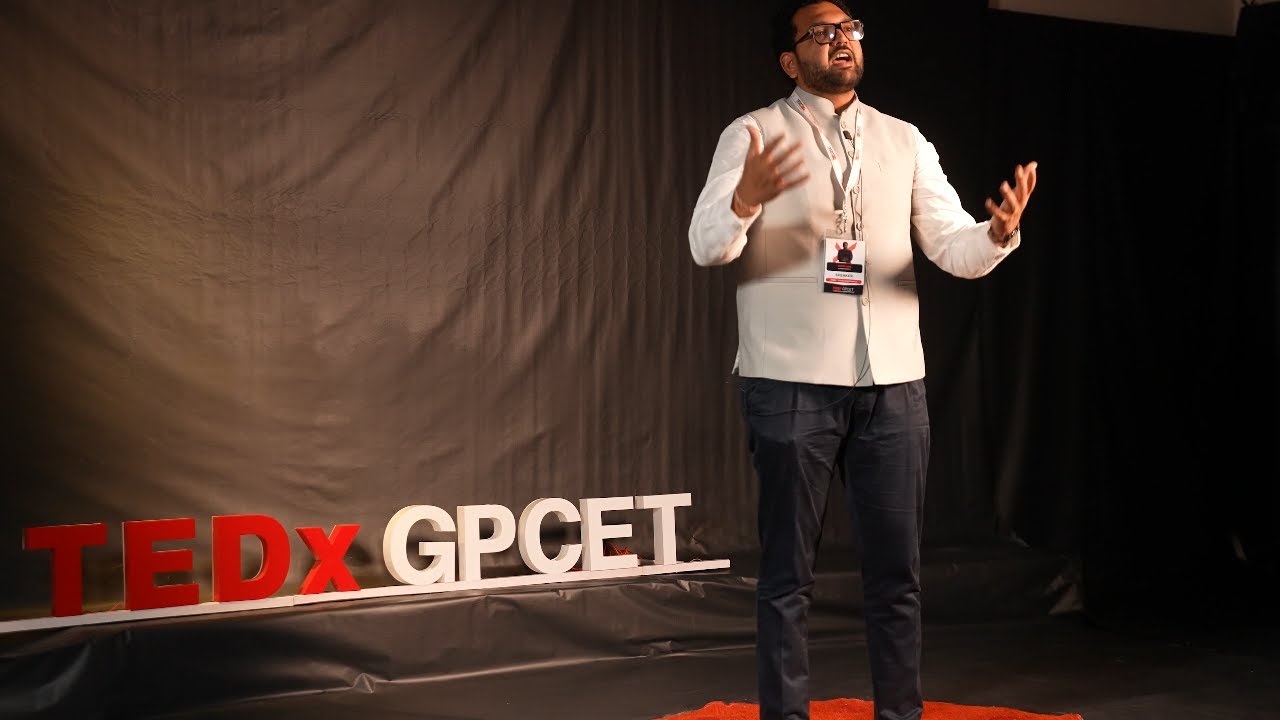
When I stepped onto the TEDx stage at GPCET in 2024, I began with a simple question: 'When was the last time you thought about what it means to see?' For most people, vision is invisible—it's so fundamental that we never consider its absence.
But for 285 million people worldwide who are blind or visually impaired, every moment is shaped by this reality. And here's the profound truth that most people miss: the challenge isn't blindness itself. The challenge is that our world is designed by sighted people for sighted people.
Streets, buildings, technology, information—all of it assumes you can see. This design bias creates what I call 'invisible barriers': obstacles that are entirely invisible to those of us with sight but are insurmountable walls for those without it.
The Technology Gap
The assistive technology industry has existed for decades, yet it has fundamentally failed the population it's meant to serve. Consider these numbers: the average advanced assistive device costs ₹5,00,000 or more. The average annual income in India is around ₹2,00,000. The math doesn't work.
This isn't just a pricing problem—it's a design philosophy problem. Traditional assistive devices were built with a clinical mindset, not a user-centric one. They were complicated, required extensive training, and often felt like medical equipment rather than everyday tools.
The result? Only 5-15% of those who could benefit from assistive technology actually have access to it. The rest navigate the world with minimal support, dependent on others for tasks that technology could easily enable.
AI as the Great Equalizer
Artificial intelligence has fundamentally changed what's possible. Unlike traditional rule-based systems, AI can understand context, learn patterns, and provide intelligent responses in real-time. For accessibility, this is revolutionary.
AI can now do what was once impossible: accurately describe complex visual scenes, recognize faces and emotions, read any document in any language, and have natural conversations. The computing power that once required roomful of servers now fits in a smartphone.
This democratization of AI capability opened a door that we at SMARTON walked through with purpose.
SMARTON's Approach
When we built SMARTON, we didn't start with the technology—we started with the people. We spent months understanding how blind individuals actually navigate their lives. What tasks were most frustrating? What information was most valuable? What interfaces felt most natural?
This research led to five core features that define SMARTON: Mira AI, our conversational assistant that answers any question about the visual world; Smart Eye, which describes surroundings in real-time; Document AI, which reads and summarizes any document; AI Tutor, which makes education accessible; and Currency Recognition, which enables financial independence.
Every feature was designed voice-first because our users told us that's how they naturally interact. Every response was optimized for brevity and utility because information overload helps no one. Every interaction was tested with real users because assumptions are the enemy of good design.
The Affordability Revolution
Perhaps our most important innovation isn't technical—it's economic. At ₹12,000, SMARTON costs about 40 times less than comparable international solutions. This wasn't achieved through compromise; it was achieved through smart design choices.
We leveraged smartphones as the processing platform, eliminating the need for expensive custom hardware. We optimized our AI models for efficiency, reducing computational requirements. We focused on software innovation, where the marginal cost of additional users approaches zero.
This pricing strategy isn't just about accessibility—it's about scalability. We can't help 285 million people with a ₹5,00,000 device. But at ₹12,000? The math finally works.
A Call to Action
I ended my TEDx talk with a challenge to the audience, and I repeat it here: inclusive design isn't charity—it's better design. Features created for accessibility often benefit everyone: voice interfaces, automatic captions, screen readers, and more.
As technologists, entrepreneurs, and citizens, we have a choice. We can continue building for the majority and leaving millions behind, or we can embrace inclusive design as a core principle. The AI revolution gives us unprecedented tools. How we use them defines what kind of future we're building.
At SMARTON, we've made our choice. The question is: what will you choose?
Watch the Full Talk